
Facial Anatomy and Anti Wrinkle Injections Belfast
Why Facial Anatomy Matters When Planning Anti- Wrinkle Injections in Belfast
Every face is different. We all have the same principal groups of facial muscles, but their size, strength, position and pattern of movement can vary considerably from one person to another.
This is why planning anti wrinkle injections should never be reduced to a standard collection of injection points. A careful practitioner needs to understand what is troubling the individual, examine the face at rest and in motion, and consider how changing the action of one muscle might influence the surrounding features.
At Woodford Medical Belfast on the Lisburn Road, we created these videos to make that thought process easier to understand.
Why we made these videos
We made these videos to help people understand the careful thought that goes into every treatment we perform.
No two faces are the same, and sometimes the differences are considerable. That is why we devote so much time to consultation. We listen carefully to what is troubling each person, assess how their face moves, and have an open and honest discussion about what may be possible and what is most likely to suit their individual features.
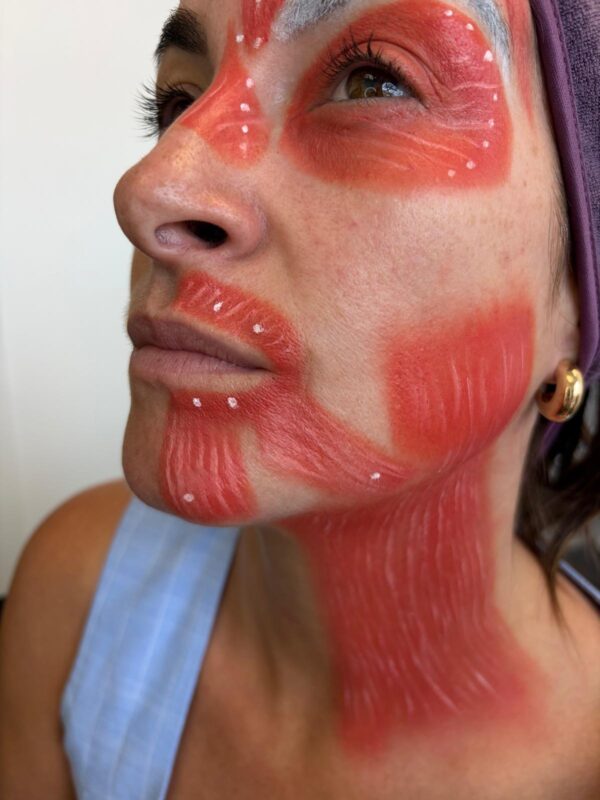
To make the anatomy easier to understand, we worked with a professional stage makeup artist who painted the underlying muscles directly onto Dennise’s face. Seeing those muscles move as she changes expression helps illustrate why treatment cannot simply follow a standard set of injection points.
Good aesthetic medicine begins with understanding the individual, their concerns, their anatomy and the way their face moves, before deciding whether any treatment is appropriate.
Part One: The muscles of the upper face
The first video examines the muscles of the upper face. These muscles allow us to raise and lower our eyebrows, frown, concentrate, squint and smile.
The forehead muscle lifts the eyebrows. Other muscles around the eyebrows pull them downwards and inwards. Around the eyes, a circular muscle helps us to close our eyelids and contributes to the lines that appear when we smile.
Although an anatomical illustration can show the usual position of these muscles, it cannot demonstrate precisely how strongly they work in a particular person. Some people naturally raise their eyebrows when speaking. Others have a powerful frown or noticeable differences between the two sides of the forehead.
These individual patterns are important. Reducing the activity of one muscle changes the balance between it and the muscles working in the opposite direction. This is why the position, strength and movement of the eyebrows must be assessed before any treatment is planned.
Part Two: The muscles of the lower face and neck
The second video looks at the lower face and neck.
The muscles in this area help us smile, speak, eat, purse our lips and move the corners of the mouth. They also contribute to the shape and movement of the jawline and neck.
This is a particularly complex area because several small muscles work close together. Some lift parts of the face while others pull downwards. A small change in one muscle may influence the smile, the position of the lips or the balance between the two sides of the face.
This helps explain why careful assessment is so important. A practitioner must consider both appearance and function. Preserving natural expression and movement is just as important as understanding the concern that has brought the person to the consultation.
Why every face needs an individual assessment
A standard facial diagram is a useful educational tool, but it is not a treatment plan.
During a consultation, we look at the face from different angles and observe it both at rest and during expression. We may ask someone to smile, frown, raise their eyebrows, close their eyes firmly, purse their lips or tense their neck.
These movements help us assess:
- The position and strength of the facial muscles
- The balance between muscles that lift and muscles that pull downwards
- Differences between the two sides of the face
- The relationship between muscle movement, facial shape and skin
- Whether one area is compensating for movement or weakness elsewhere
- Whether the person’s expectations are realistic and achievable
The consultation is also an opportunity to understand what is actually troubling the person. This is not always the feature they initially mention. A frank conversation may reveal that a different approach would be more appropriate, or that treatment would be unlikely to achieve the result they have in mind.
Sometimes the most responsible recommendation is to suggest a different option or not to proceed with treatment at all.
The aim is not to remove every expression
Facial movement is an essential part of communication. Our expressions convey warmth, interest, amusement, concern and many other emotions.
The purpose of a thoughtful treatment plan is not simply to stop muscles moving. It is to consider whether selected muscle activity can be modified while maintaining a natural and balanced appearance.
This requires judgement. Too much reduction in movement may produce an unnatural result. Treating one area without considering the surrounding muscles may alter eyebrow position, facial balance or expression.
The question is therefore not simply, “Where should the injections go?” A better question is, “What is this individual hoping to change, how does their face move, and what approach is most appropriate for them?”
Common questions about anti-wrinkle injections
What are anti wrinkle injections and how do they work?
Anti wrinkle injections use a prescription only medicine that temporarily reduces communication between selected nerves and muscles. This decreases the strength of contraction in the muscles that have been treated.
As the activity of a selected muscle reduces, lines caused by repeated facial movement may appear softer. The effect is temporary and varies between individuals.
Treatment does not improve every type of line or every concern. Lines may also be influenced by skin quality, sun exposure, loss of facial volume and changes in the underlying facial structure. A consultation is therefore necessary to determine what is contributing to the concern.
How do practitioners decide where to place anti wrinkle injections?
Injection placement should be based on an examination of the individual face rather than a standard diagram.
The practitioner considers the location and strength of the muscles, the direction in which they pull, the person’s pattern of expression and the balance between neighbouring muscles. The face should be observed at rest and during movement.
The treatment plan may also need to account for natural asymmetry, eyebrow position, previous treatment and the result the person wishes to achieve.
This is why two people concerned about the same facial line may require different approaches.
Why should anti wrinkle treatment be tailored to each individual face?
Although people share the same main groups of facial muscles, those muscles do not behave identically in everyone.
Muscle strength, facial proportions, eyebrow position, skin quality and patterns of expression all vary. One person may have a strong forehead muscle, while another may rely on that muscle to help support the position of the eyebrows. One side of the face may also move more strongly than the other.
A plan that suits one person may therefore be inappropriate for somebody else. Individual assessment helps the practitioner decide whether treatment is suitable and how natural expression and facial balance may be preserved.
Will anti wrinkle injections make my face look frozen or affect my expressions?
Anti wrinkle injections are intended to reduce the activity of selected muscles, so some change in movement is expected. The degree of change depends on the muscles treated, the amount prescribed and the individual response.
A careful treatment plan aims to soften unwanted muscular activity without unnecessarily removing natural expression. However, no medical procedure can guarantee a particular aesthetic result.
It is important to discuss how much movement you would like to retain and what you mean by a natural result during the consultation. This allows the practitioner to understand your priorities and explain what may realistically be achieved.
How long do anti wrinkle injections take to work and how long do the results last?
The effect develops gradually rather than immediately. Some people notice an initial change within several days, although the timing and full effect vary according to the product used, the area treated and the individual response.
For commonly treated facial lines, improvement may become noticeable within approximately one week. The effect is temporary and often lasts for around three to four months, although it may last for a shorter or longer period in an individual patient.
Your practitioner should explain when the result can reasonably be assessed and whether a review appointment is appropriate.
Are anti wrinkle injections safe and what are the possible side effects?
As with any medical treatment, anti wrinkle injections have potential risks and side effects. A thorough consultation allows your medical history, individual concerns and suitability for treatment to be carefully considered.
Possible effects include temporary discomfort, redness, swelling or bruising at the injection site. Headache, unwanted muscle weakness, asymmetry and a temporary lowering of an eyebrow or eyelid can also occur, depending on the treatment area and individual response.
Your practitioner should discuss the relevant benefits, limitations and possible side effects with you before you decide whether to proceed.
Understanding the person behind the treatment
The painted muscles in these videos show the anatomy beneath facial expression, but the most important message is that anatomy cannot be separated from the individual.
A successful consultation involves more than looking at a line or selecting an injection point. It requires listening to the person, understanding what is troubling them, observing how their face moves and discussing honestly what treatment may or may not achieve.
The aim should always be an individual plan based on sound anatomical knowledge, careful assessment and realistic expectations.
Facial assessment at our Belfast clinic
At Woodford Medical Belfast, every treatment journey begins with an individual consultation. Our clinic on the Lisburn Road welcomes patients from Belfast and across Northern Ireland who would like considered medical advice about facial ageing, expression and the treatments that may be appropriate for them.
The consultation is an opportunity to explain what is troubling you, have your face assessed at rest and during movement, and receive an honest opinion about what may or may not suit your individual features.